Work life balance
Read skill description
Work-life balance is the ability to manage work and personal life in a healthy and sustainable way. It means giving enough time and attention to work while also making time for family, friends, hobbies, health and rest. A good work-life balance helps people stay productive without becoming exhausted.
Many people believe that working longer hours always leads to better results. In reality, this is often not true. When people work too much without taking breaks or making time for their personal lives, they may become tired, lose motivation and make more mistakes. Over time, this can lead to stress, poor health or even burnout.
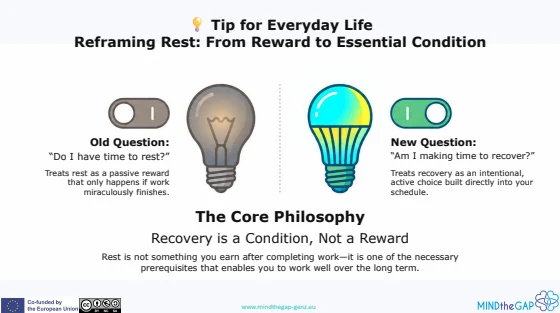
A healthy work-life balance does not mean spending exactly the same amount of time on work and personal life every day. Some periods are naturally busier than others. The important thing is to make sure that work does not permanently take over all other parts of life. Everyone needs time to recover, relax and enjoy activities outside work.
Setting boundaries is an important part of work-life balance. This may include finishing work at a reasonable time, taking regular breaks, avoiding unnecessary overtime and disconnecting from work during evenings, weekends or holidays whenever possible. Good planning and communication also help employees manage their responsibilities without becoming overwhelmed.
In the workplace, employees with a healthy work-life balance are often more focused, motivated and productive. They are less likely to experience long-term stress and more likely to enjoy their work. They also tend to have better relationships with colleagues because they have more energy and patience.
Employers also benefit when employees maintain a good work-life balance. Healthy employees are usually more engaged, take fewer sick days and remain with the organisation longer. Creating a workplace that supports wellbeing benefits both employees and the organisation.
For Generation Z employees, work-life balance is especially important because many jobs involve flexible working hours, remote work and constant digital communication. Smartphones and online platforms make it easy to stay connected to work at any time. Learning how to set healthy boundaries helps young employees protect their wellbeing while building successful and sustainable careers.
Learn about the skill
Module
Watch the video
Check your knowledge
Quiz
Improve this skill
Activities for improving this skill
Reflection Challenge
 Open illustrated activity PDF (new tab)
Reflection Challenge
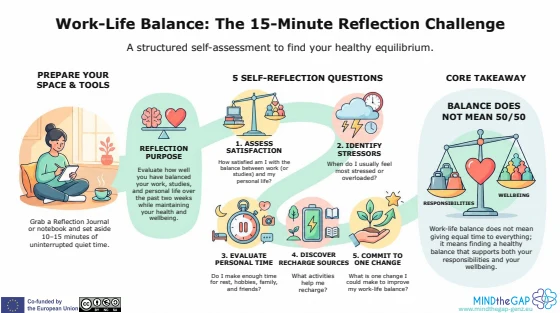
Purpose: Reflect on how well you balance your work, studies and personal life while maintaining your health and wellbeing.
Think about the past two weeks. Write short answers to the following questions:
- How satisfied am I with the balance between work (or studies) and my personal life?
- When do I usually feel most stressed or overloaded?
- Do I make enough time for rest, hobbies, family and friends?
- What activities help me recharge?
- What is one change I could make to improve my work-life balance?
Remember that work-life balance does not mean giving equal time to everything. It means finding a healthy balance that supports both your responsibilities and your wellbeing.
Materials needed: Toolkit T1 (Reflection Journal) or notebook
Approximate duration: 10–15 minutes
Learning toolkits
Competence Builder 1 - My Time Balance Wheel
 Open illustrated activity PDF (new tab)
Competence Builder 1 - My Time Balance Wheel
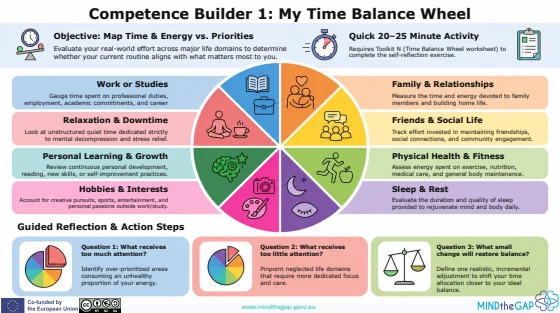
Objective: Identify how you currently spend your time and whether it reflects your priorities.
Complete the Time Balance Wheel by estimating how much time and energy you currently invest in different areas of your life, such as:
- Work or studies
- Family
- Friends
- Physical health
- Sleep
- Hobbies
- Personal learning
- Relaxation
After completing the wheel, answer the following questions:
- Which area receives too much attention?
- Which area receives too little attention?
- What small change could improve my overall balance?
Materials needed: T14 (Time Balance Wheel worksheet)
Approximate duration: 20–25 minutes
Learning toolkits
Competence Builder 2 - My Healthy Week Challenge
 Open illustrated activity PDF (new tab)
Competence Builder 2 - My Healthy Week Challenge
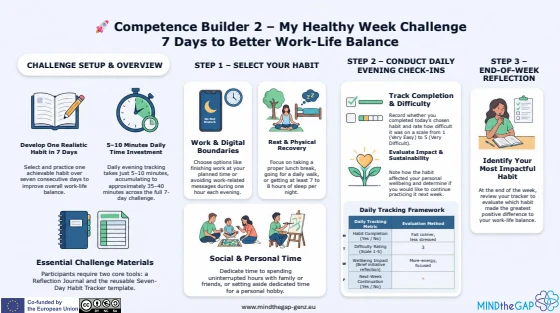
Objective: Develop one realistic habit that improves your work-life balance.
Choose one healthy habit that you would like to practise during the next seven days.
Examples include:
- finishing work at your planned time,
- avoiding work-related messages during one hour each evening,
- taking a proper lunch break,
- going for a daily walk,
- sleeping at least seven to eight hours,
- spending uninterrupted time with family or friends,
- setting aside time for a hobby.
Each evening, briefly record:
- Did I complete today's habit?
- How difficult was it? (1–5)
- How did it affect my wellbeing?
- Would I like to continue this habit next week?
At the end of the week, reflect on which habit made the greatest positive difference.
Materials needed: Toolkit T1 (Reflection Journal), Toolkit T2 (Seven-Day Habit Tracker)
Approximate duration: 5–10 minutes each day (approximately 35–40 minutes over one week)
Learning toolkits
 Open illustrated activity PDF (new tab)