Time Management
Read skill description
Time management is the ability to plan and organise your time so that you can complete tasks efficiently and achieve your goals. It helps people decide what needs to be done first, how long different tasks may take and how to avoid unnecessary delays. Good time management reduces stress, improves productivity and helps people meet deadlines.
Everyone has the same twenty-four hours in a day, but people use their time differently. Good time management is not about being busy all the time. It is about using time wisely by focusing on the most important tasks and avoiding unnecessary distractions.
Planning is one of the key parts of time management. Employees who plan their work usually know what they need to do, when tasks should be completed and which activities are most important. They often use calendars, task lists or digital planning tools to organise their work.
Prioritising is equally important. Sometimes several tasks need attention at the same time. Good time management helps people decide which tasks are urgent, which are important and which can wait. This helps prevent last-minute stress and improves the quality of work.
Time management also includes dealing with distractions and procrastination. Social media, emails, unnecessary meetings or constantly switching between tasks can reduce concentration and waste valuable time. Learning to focus on one task at a time often leads to better results than trying to do many things at once.
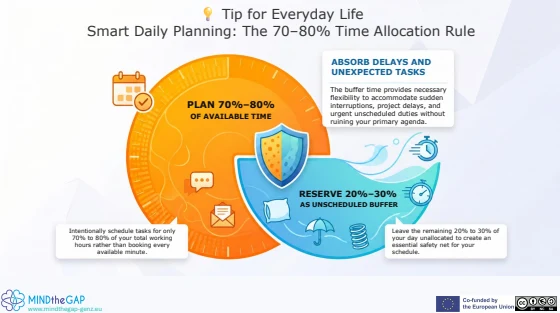
Good time management does not mean following a rigid schedule every minute of the day. Unexpected situations happen in every workplace. Employees need enough flexibility to adjust their plans while still keeping their main priorities in mind.
For Generation Z employees, time management is becoming increasingly important because they often manage several responsibilities at the same time, including work, study, family and social life. They also work in digital environments where distractions are always present. Strong time management skills help young employees stay organised, reduce stress and achieve their goals more effectively.
Learn about the skill
Module
Watch the video
Listen the podcast
Coming soon.
Check your knowledge
Coming soon.
Improve this skill
Activities for improving this skill
Reflection Challenge
 Open illustrated activity PDF (new tab)
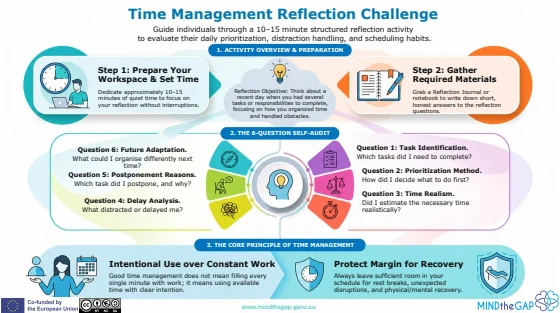
Reflection Challenge
Purpose: Reflect on how you organise your time, set priorities and deal with delays or distractions.
Think about a recent day when you had several tasks or responsibilities to complete. Write short answers to the following questions:
- Which tasks did I need to complete?
- How did I decide what to do first?
- Did I estimate the necessary time realistically?
- What distracted or delayed me?
- Which task did I postpone, and why?
- What could I organise differently next time?
Remember that good time management does not mean filling every minute with work. It means using your available time intentionally and leaving enough space for breaks, unexpected events and recovery.
Materials needed: Toolkit T1 (Reflection Journal) or notebook
Approximate duration: 10–15 minutes
Learning toolkits
Competence Builder 1 – My Priority Planner
 Open illustrated activity PDF (new tab)
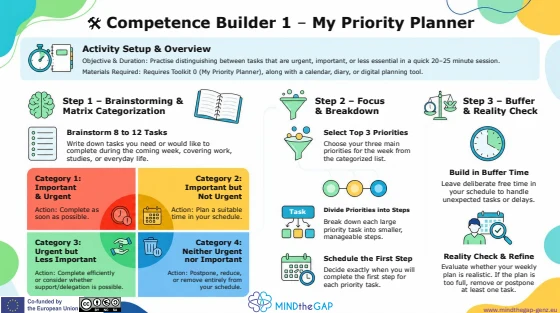
Competence Builder 1 – My Priority Planner
Objective: Practise distinguishing between tasks that are urgent, important or less essential.
Write down between eight and twelve tasks that you need or would like to complete during the coming week. These may relate to work, studies or everyday life. Place each task into one of four categories:
- Important and urgent – complete as soon as possible.
- Important but not urgent – plan a suitable time.
- Urgent but less important – complete efficiently or consider whether support is possible.
- Neither urgent nor important – postpone, reduce or remove.
Then:
- select your three main priorities for the week;
- divide each large priority into smaller steps;
- decide when you will complete the first step;
- leave some free time for unexpected tasks.
At the end, check whether your weekly plan is realistic. Remove or postpone at least one task if the plan is too full.
Materials needed: Toolkit T15 (My Priority Planner), calendar, diary or digital planning tool
Approximate duration: 20–25 minutes
Learning toolkits
Competence Builder 2 – Plan, Estimate and Compare
 Open illustrated activity PDF (new tab)
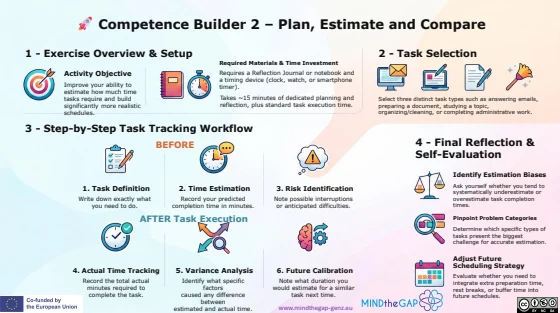
Competence Builder 2 – Plan, Estimate and Compare
Objective: Improve your ability to estimate how much time tasks require and create more realistic schedules.
Choose three tasks that you will complete during the next two days. The tasks should be different, for example:
- answering emails,
- preparing a document,
- studying a topic,
- cleaning or organising something,
- completing an administrative task.
Before starting each task, write down:
- what you need to do;
- how many minutes you think it will take;
- possible interruptions or difficulties.
After completing it, record:
- the actual time required;
- what caused any difference between the estimated and actual time;
- what you would estimate next time.
After completing all three tasks, compare your results.
Ask yourself:
- Do I usually underestimate or overestimate time?
- Which types of tasks are hardest for me to estimate?
- Should I include more preparation time, breaks or buffer time in future plans?
Materials needed: T1 (Reflection Journal) or notebook, clock, watch or smartphone timer
Approximate duration: Approximately 15 minutes of planning and reflection, in addition to the normal time needed for the three tasks
Learning toolkits
 Open illustrated activity PDF (new tab)